
How to measure knee range of motion
Clinical guide · Reviewed by Kevin Lan, OTR/L, ATP · Updated July 2026
To measure knee range of motion with a goniometer, position the patient supine, center the fulcrum over the lateral epicondyle of the femur, align the proximal arm toward the greater trochanter and the distal arm toward the lateral malleolus, then move the knee to its end range and read the angle. Normal knee ROM is about 0° of extension to 135° of flexion (AAOS). The steps, landmarks, and reliability evidence are below.
Measure knee ROM on your iPhone. Guided placement with the AAOS normal on screen — lay the phone along the shin and read the angle. Free to measure. Get the free app
 Scan with your iPhone camera to get Goniometer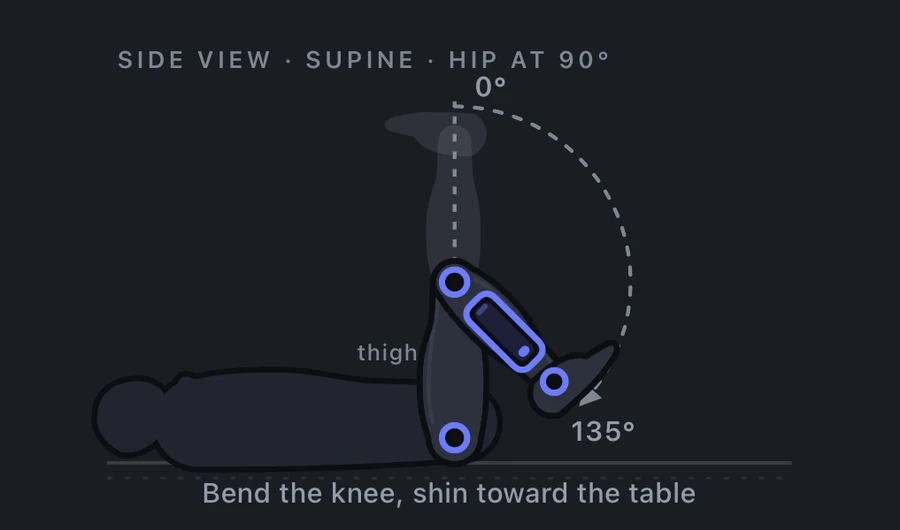
Normal knee range of motion
| Movement | Normal ROM |
|---|---|
| Extension | 0° |
| Flexion | 135° |
Extension of 0° means the leg straightens fully; a knee that cannot reach 0° has an extension deficit (recorded as a negative value, e.g. −10°), while a knee that goes past 0° is in hyperextension. See the full normal range of motion chart for every joint.
What you need
- A universal goniometer, digital goniometer, or a smartphone goniometer app.
- A firm surface where the patient can lie supine with the leg free to move.
- Reference to the three bony landmarks: greater trochanter, lateral femoral epicondyle, lateral malleolus.
How to measure knee flexion, step by step
- Position the patient. Supine, leg extended and relaxed — this is the 0° starting position.
- Find the landmarks. Palpate the greater trochanter at the hip, the lateral epicondyle of the femur at the knee, and the lateral malleolus at the ankle.
- Center the fulcrum. Place the goniometer's axis over the lateral epicondyle of the femur.
- Align the arms. Line the proximal (stationary) arm along the femur toward the greater trochanter, and the distal (moving) arm along the fibula toward the lateral malleolus.
- Move to end range. Flex the knee smoothly until it stops, keeping both arms tracking the same landmarks.
- Read and record. Read the angle at end range and note the side (L/R) and patient position so the next measurement matches.
How to measure knee extension
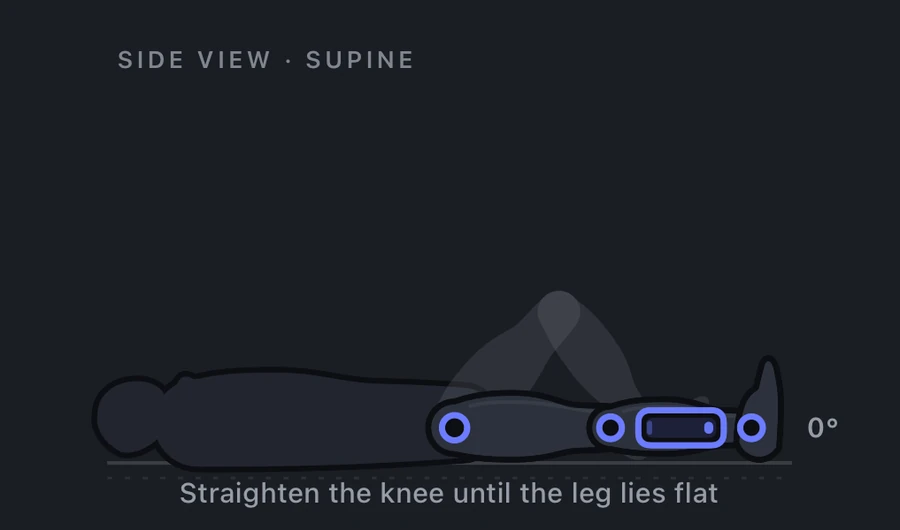
Keep the patient supine with the leg straight. A knee that rests flat on the table reads 0°. If it cannot fully straighten, measure how many degrees short of 0° it is and record that as an extension deficit (a lack of extension). If it moves past neutral, that is hyperextension. Because extension is referenced to the straight leg, keep the same supine position and the same landmarks used for flexion.
Getting a reliable measurement
Research consistently shows goniometry is most reliable when the same examiner measures the same way each time. Watkins and colleagues, measuring knees in a clinical setting, found intratester (same-examiner) reliability of ICC 0.99 for flexion and 0.98 for extension, but lower intertester (different-examiner) reliability of ICC 0.90 and 0.86. A later systematic comparison of knee goniometry methods reached the same conclusion — technique and consistency matter more than the specific instrument. Four habits keep readings repeatable:
- Standardize the position. Measure supine every time, with the hip in the same position.
- Palpate the landmarks each time rather than eyeballing them — landmarking is the biggest source of variation.
- Read at a stable end range, not mid-motion, and to the whole degree.
- Use one examiner for progress tracking. Compare a patient's knee to their own earlier measurement, taken the same way.
Measuring knee ROM with an iPhone
A smartphone goniometer app replaces the two-armed goniometer with the phone's gravity-referenced motion sensor: lay the phone along the shin, set zero, and the change in tilt as the knee bends is the joint angle. Peer-reviewed research finds smartphone inclinometry valid and reliable for knee ROM, comparable to a universal goniometer — see the accuracy evidence. The knee is the best-validated joint of all: smartphone measurement was non-inferior to goniometry against radiographs (Dietz et al.), agreed with a surgical navigation system within about a degree intraoperatively (Jenny), and showed smaller measurement error than the universal goniometer in clinicians' hands (SEM 0.62° vs. 1.56°, Milanese et al.). It needs one hand and one placement instead of aligning two arms over a moving fulcrum, and it records the result with the AAOS normal range beside it.
Measure the knee on your iPhone. Goniometer shows animated placement for knee flexion and extension, with the AAOS normal range beside every reading — free to measure. Readings save to patient profiles and export as PDF or CSV reports, and patient data stays encrypted on the device. Download Goniometer on the App Store.
Frequently asked questions
What is normal knee range of motion?
About 0° of extension (a fully straight leg) to 135° of flexion, per AAOS. Some sources cite up to 140°; values vary with age and body type.
How do you measure knee flexion with a goniometer?
With the patient supine, center the fulcrum over the lateral epicondyle of the femur, align the proximal arm toward the greater trochanter and the distal arm toward the lateral malleolus, flex the knee to end range, and read the angle in degrees.
What landmarks are used to measure the knee?
Three bony landmarks: the greater trochanter (proximal), the lateral epicondyle of the femur (axis/fulcrum), and the lateral malleolus (distal), as described by Norkin and White.
How reliable is goniometric knee measurement?
Very reliable with one examiner: Watkins et al. reported intratester ICC of 0.99 (flexion) and 0.98 (extension), and intertester ICC of 0.90 and 0.86. Consistency of technique drives reliability.
Can you measure knee range of motion with a phone?
Yes — a smartphone goniometer app reads the phone's gravity-referenced motion sensor, and inclinometry has shown validity and reliability comparable to a universal goniometer in peer-reviewed research.
References
- Norkin CC, White DJ. Measurement of Joint Motion: A Guide to Goniometry. 5th ed. Philadelphia: F.A. Davis; 2016.
- American Academy of Orthopaedic Surgeons. Joint Motion: Method of Measuring and Recording. Chicago: AAOS; 1965. Normative range-of-motion reference values, as used throughout the Goniometer app.
- Watkins MA, Riddle DL, Lamb RL, Personius WJ. Reliability of goniometric measurements and visual estimates of knee range of motion obtained in a clinical setting. Physical Therapy. 1991;71(2):90–96. pubmed.ncbi.nlm.nih.gov/1989012
- Hancock GE, Hepworth T, Wembridge K. Accuracy and reliability of knee goniometry methods. Journal of Experimental Orthopaedics. 2018;5(1):46. doi:10.1186/s40634-018-0161-5
- Keogh JWL, Cox A, Anderson S, et al. Reliability and validity of clinically accessible smartphone applications to measure joint range of motion: A systematic review. PLOS ONE. 2019;14(5):e0215806. doi:10.1371/journal.pone.0215806
- Dietz MJ, Sprando D, Hanselman AE, Regier MD, Frye BM. Smartphone assessment of knee flexion compared to radiographic standards. Knee. 2017;24(2):224-230. doi:10.1016/j.knee.2016.11.014
- Jenny JY. Measurement of the knee flexion angle with a Smartphone-application is precise and accurate. J Arthroplasty. 2013;28(5):784-787. doi:10.1016/j.arth.2012.11.013
- Milanese S, Gordon S, Buettner P, et al. Reliability and concurrent validity of knee angle measurement: Smart phone app versus universal goniometer used by experienced and novice clinicians. Man Ther. 2014;19(6):569-574. doi:10.1016/j.math.2014.05.009
Related guides
Goniometer is an educational and reference tool. It is not a medical device and is not intended for diagnosis or treatment decisions.