
How to measure cervical (neck) range of motion
Clinical guide · Reviewed by Kevin Lan, OTR/L, ATP · Updated July 2026
To measure cervical flexion, seat the patient upright looking straight ahead, zero a gravity inclinometer (or a phone held against the head) at neutral, then tip the head forward, chin toward the chest, and read the change in angle. For the neck, an inclinometer is more reliable than a universal goniometer. Normal cervical ROM is about 45° flexion, 45° extension, 45° lateral flexion, and 60° rotation (AAOS). The steps and evidence are below.
Measure cervical ROM on your iPhone. Guided placement with the AAOS normal on screen — hold the phone against the head and read the angle. Free to measure. Get the free app
 Scan with your iPhone camera to get Goniometer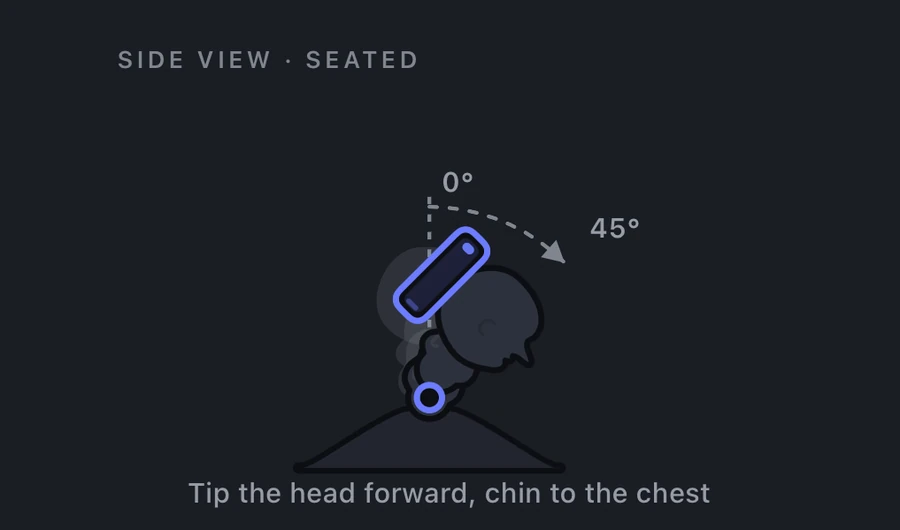
Normal cervical spine range of motion
| Movement | Normal ROM |
|---|---|
| Flexion | 45° |
| Extension | 45° |
| Lateral flexion (each side) | 45° |
| Rotation (each side) | 60° |
See the full normal range of motion chart for every joint. The Goniometer app guides cervical flexion, extension, lateral flexion, and rotation with animated placement.
What you need
- A gravity inclinometer or a smartphone goniometer app held against the head (more reliable than a universal goniometer for the neck).
- A chair with back support so the patient sits upright without slouching.
- A neutral starting position: seated tall, eyes forward, head level.
How to measure cervical flexion, step by step
- Position the patient. Seated upright with back support, looking straight ahead, head level — this is the neutral 0° starting position.
- Set zero at neutral. Hold the inclinometer or phone flat against the side of the head and zero the reading at the upright neutral position.
- Stabilize the trunk. Keep the shoulders and trunk still so the movement comes from the neck, not the upper back.
- Move to end range. Tip the head forward, bringing the chin toward the chest, until it stops.
- Read and record. Read the change in angle from neutral and note the movement and any pain limit.
Cervical extension
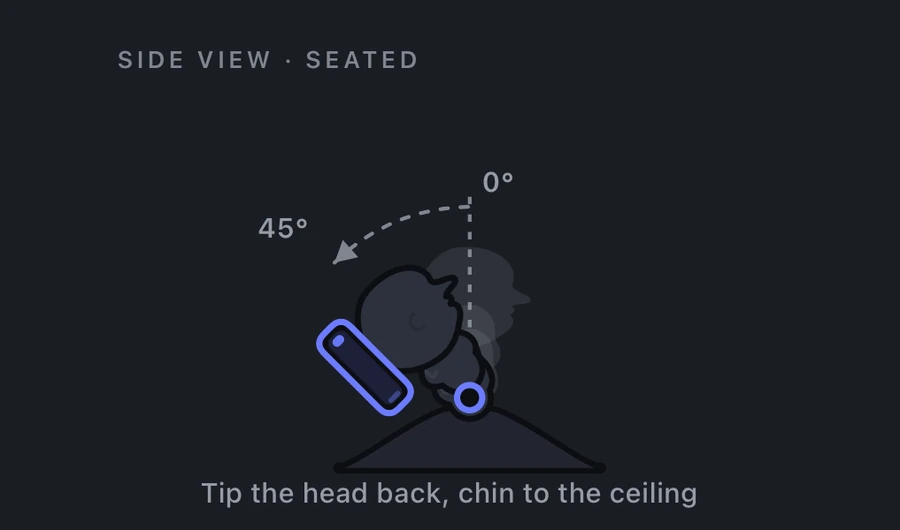
Zero at neutral, then tip the head back to look up; normal is about 45°. Read the change from neutral.
Lateral flexion
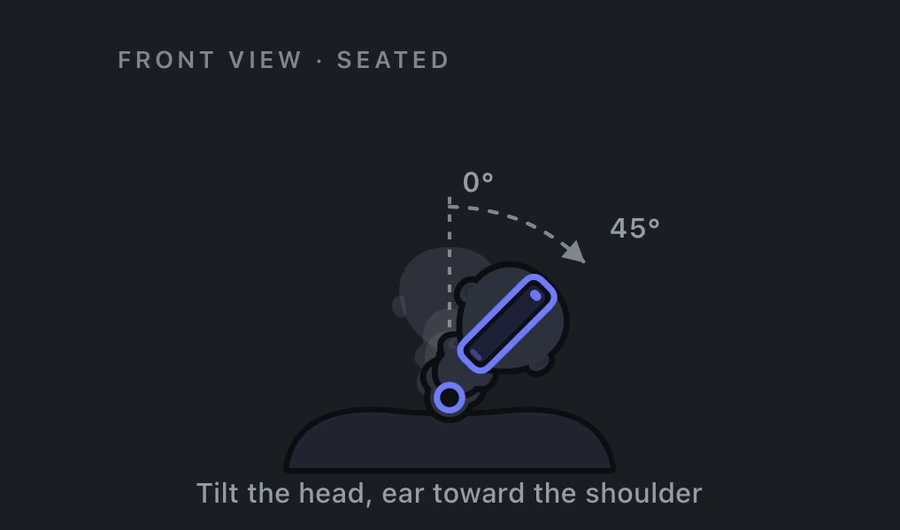
Tip the ear toward the shoulder without rotating the head or lifting the shoulder; normal is about 45° to each side.
Cervical rotation
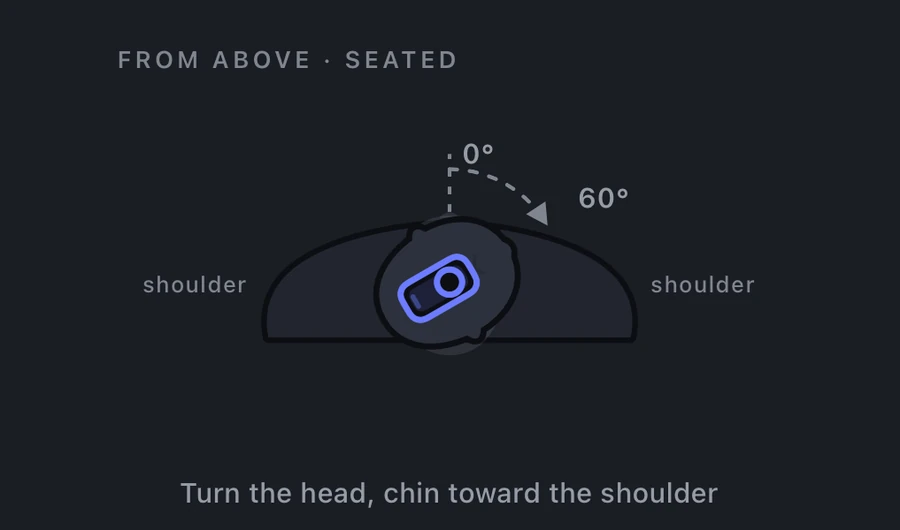
Turn the head to look over the shoulder; normal is about 60° to each side. Rotation is measured about the vertical axis, which the Goniometer app reads with the phone’s attitude reference while held against the head.
Getting a reliable measurement
For the cervical spine, the measurement method matters. Youdas and colleagues compared three methods and found the universal goniometer the least reliable, while a gravity-based cervical range-of-motion device was the most reliable (ICC .91 to .95). This is why an inclinometer — or a phone used as one — is preferred for the neck. Because neck and shoulder complaints frequently overlap, cervical motion is often documented alongside shoulder range of motion in an upper-quarter examination. Four habits keep readings repeatable:
- Use an inclinometer or phone, not a universal goniometer, for the neck — it was the more reliable method.
- Sit the patient tall with back support and stabilize the trunk so the upper back doesn’t contribute motion.
- Zero at a consistent neutral position each time before moving.
- Use one examiner for progress tracking. Compare a patient’s neck to their own earlier measurement, taken the same way.
Measuring cervical spine ROM with an iPhone
A smartphone goniometer app works as a gravity inclinometer for the neck: hold the phone against the head, set zero at neutral, and the change in orientation as the head moves is the joint angle. Because an inclinometer outperforms the universal goniometer for cervical motion, the phone method is well suited here — see the accuracy evidence. A 2019 study found two smartphone apps showed excellent validity against a CROM device, with excellent reliability for most cervical movements (Rodríguez-Sanz et al.).
Measure the cervical spine on your iPhone. Goniometer shows animated placement for cervical flexion, extension, lateral flexion, and rotation, with the AAOS normal range beside every reading — free to measure. Readings save to patient profiles and export as PDF or CSV reports, and patient data stays encrypted on the device. Download Goniometer on the App Store.
Frequently asked questions
What is normal cervical (neck) range of motion?
About 45° flexion, 45° extension, 45° lateral flexion to each side, and 60° rotation to each side, per AAOS.
How do you measure neck range of motion?
Seat the patient upright, zero an inclinometer or phone held against the head at neutral, move the head to end range (for flexion, chin toward the chest), and read the change in angle.
What is the best tool to measure cervical range of motion?
A gravity inclinometer or a phone used as one, or a dedicated CROM device — these are more reliable than a universal goniometer for the neck.
How reliable is cervical range of motion measurement?
It depends on the method: Youdas et al. found the universal goniometer the least reliable and a gravity-based CROM device the most reliable (ICC .91 to .95).
Can you measure neck range of motion with a phone?
Yes — a phone works as a gravity inclinometer, and inclinometry is the more reliable approach for the neck compared with a universal goniometer.
References
- Norkin CC, White DJ. Measurement of Joint Motion: A Guide to Goniometry. 5th ed. Philadelphia: F.A. Davis; 2016.
- American Academy of Orthopaedic Surgeons. Joint Motion: Method of Measuring and Recording. Chicago: AAOS; 1965. Normative range-of-motion reference values, as used throughout the Goniometer app.
- Youdas JW, Carey JR, Garrett TR. Reliability of measurements of cervical spine range of motion—comparison of three methods. Physical Therapy. 1991;71(2):98–104. pubmed.ncbi.nlm.nih.gov/1989013
- Rodríguez-Sanz J, Carrasco-Uribarren A, Cabanillas-Barea S, et al. Validity and reliability of two smartphone applications to measure the lower and upper cervical spine range of motion in subjects with chronic cervical pain. Journal of Back and Musculoskeletal Rehabilitation. 2019;32(4):619–627. doi:10.3233/BMR-181260
- Keogh JWL, Cox A, Anderson S, et al. Reliability and validity of clinically accessible smartphone applications to measure joint range of motion: A systematic review. PLOS ONE. 2019;14(5):e0215806. doi:10.1371/journal.pone.0215806
Related guides
Goniometer is an educational and reference tool. It is not a medical device and is not intended for diagnosis or treatment decisions.