
How to measure shoulder range of motion
Clinical guide · Reviewed by Kevin Lan, OTR/L, ATP · Updated August 2026
To measure shoulder flexion with a goniometer, position the patient supine with the arm at the side, center the fulcrum over the lateral aspect of the acromion, align the stationary arm with the midaxillary line of the trunk and the moving arm with the lateral midline of the humerus, then raise the arm overhead and read the angle. Normal shoulder ROM is about 180° flexion, 180° abduction, and 90° external rotation (AAOS). The steps, landmarks, and reliability evidence are below.
Measure shoulder ROM on your iPhone. Guided placement with the AAOS normal on screen — lay the phone along the upper arm and read the angle. Free to measure. Get the free app
 Scan with your iPhone camera to get Goniometer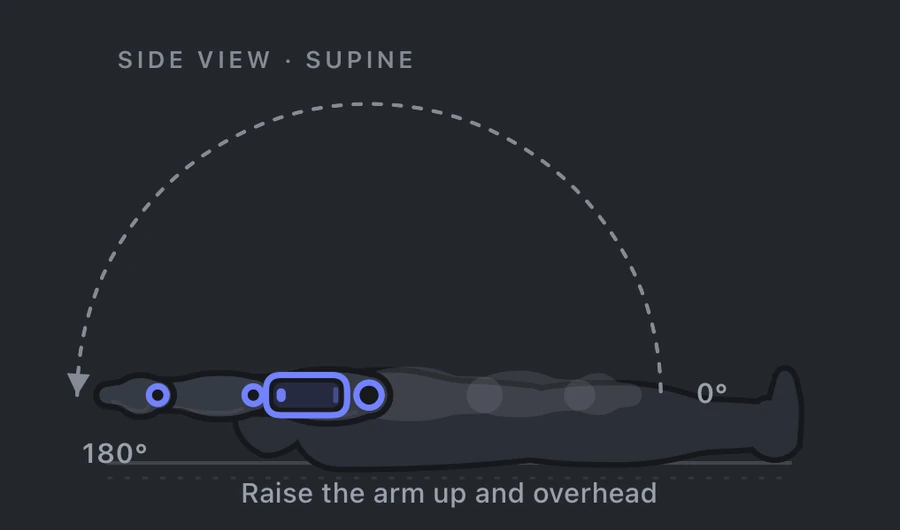
Normal shoulder range of motion
| Movement | Normal ROM |
|---|---|
| Flexion | 180° |
| Extension | 60° |
| Abduction | 180° |
| Adduction | 40° |
| External (lateral) rotation | 90° |
| Internal (medial) rotation | 70° |
See the full normal range of motion chart for every joint. The Goniometer app guides flexion, extension, abduction, and internal and external rotation with animated placement.
What you need
- A universal goniometer, digital goniometer, or a smartphone goniometer app.
- A table where the patient can lie supine with the arm free to move overhead.
- Reference to the landmarks: the acromion process, the lateral midline of the humerus (toward the lateral epicondyle), and the midaxillary line of the trunk.
How to measure shoulder flexion, step by step
- Position the patient. Supine with the arm at the side and the palm facing the body — this is the 0° starting position.
- Find the landmarks. Locate the acromion process, the lateral midline of the humerus toward the lateral epicondyle, and the midaxillary line of the trunk.
- Center the fulcrum. Place the goniometer axis over the lateral aspect of the acromion.
- Align the arms. Line the stationary arm along the midaxillary line of the trunk and the moving arm along the lateral midline of the humerus.
- Move to end range. Raise the arm forward and overhead until it stops, keeping the arms tracking the same landmarks.
- Read and record. Read the angle at end range and note the side (L/R) and patient position.
Goniometer placement: Fulcrum and arm alignment
The fulcrum (axis), stationary arm, and moving arm placements for each shoulder movement, per standard goniometry technique (Norkin & White):
| Movement | Fulcrum (axis) | Stationary arm | Moving arm |
|---|---|---|---|
| Flexion | Lateral aspect of the acromion | Midaxillary line of the trunk | Lateral midline of the humerus, toward the lateral epicondyle |
| Extension | Lateral aspect of the acromion | Midaxillary line of the trunk | Lateral midline of the humerus, toward the lateral epicondyle |
| Abduction | Anterior aspect of the acromion | Parallel to the midline of the anterior sternum | Medial midline of the humerus |
| External rotation | Olecranon process (through the long axis of the humerus) | Perpendicular to the floor | Ulna, toward the ulnar styloid |
| Internal rotation | Olecranon process (through the long axis of the humerus) | Perpendicular to the floor | Ulna, toward the ulnar styloid |
For shoulder flexion, the fulcrum sits over the lateral aspect of the acromion process. With a smartphone goniometer app there is no fulcrum to center — the phone lies along the moving segment (the humerus) and the sensor reads the arc directly, which removes the landmarking step where most examiner-to-examiner variation comes from.
Shoulder extension
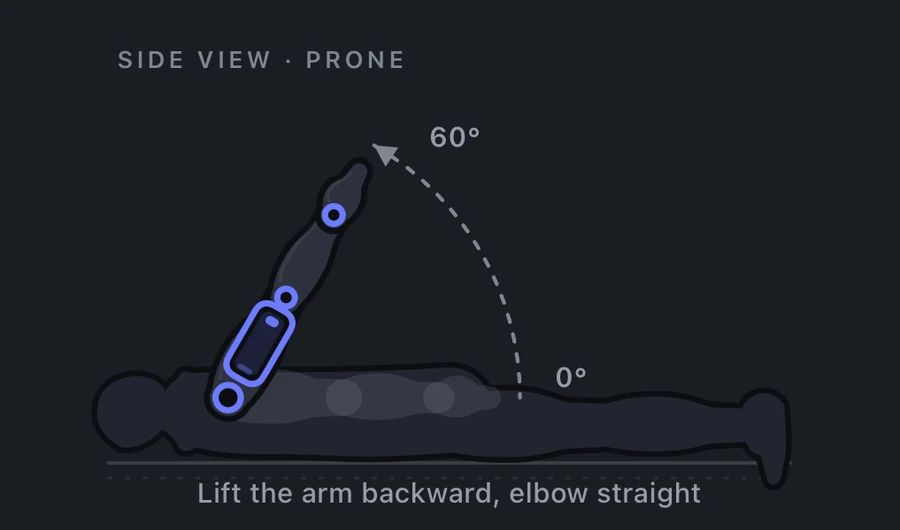
Position the patient prone with the arm resting along the side, then lift the arm backward toward the ceiling in the sagittal plane. Normal extension is about 60°. In the Goniometer app the phone lies along the humerus and reads 0° automatically with the arm flat, so there is no fulcrum to center; a side-lying or seated start is also supported.
Shoulder abduction
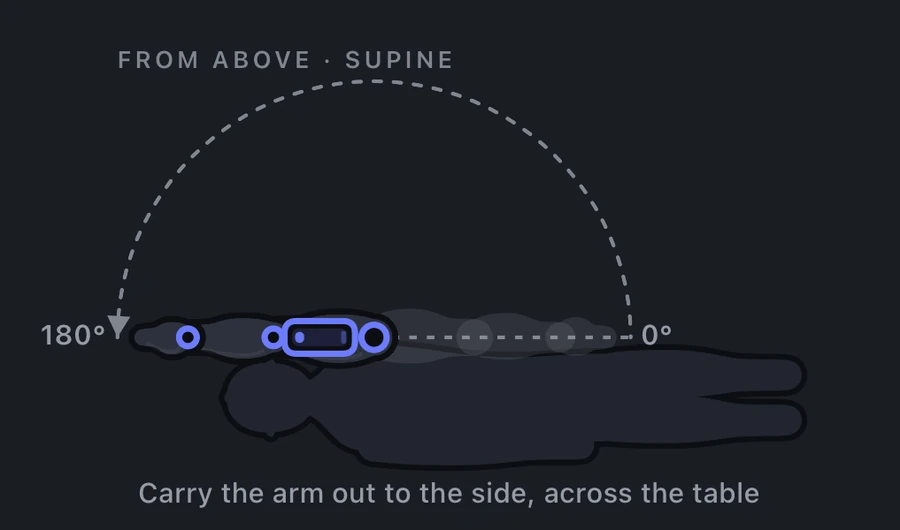
Keep the patient supine and move the arm out to the side and overhead in the frontal plane, with the fulcrum near the anterior acromion. Normal abduction is about 180°.
Shoulder external rotation
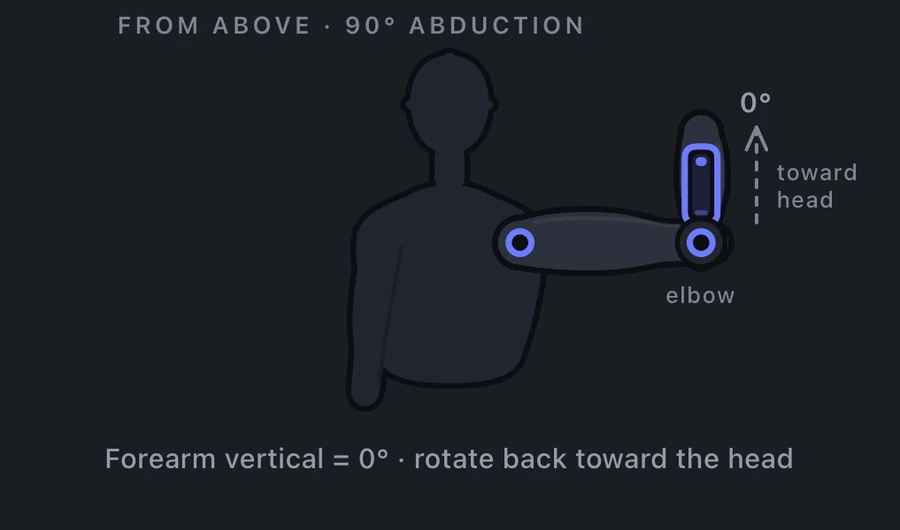
Abduct the shoulder to 90° with the elbow bent to 90°, then rotate the forearm back toward the head. Normal is about 90°. In the Goniometer app this uses the phone’s attitude reference so it reads true rotation in any orientation.
Shoulder internal rotation
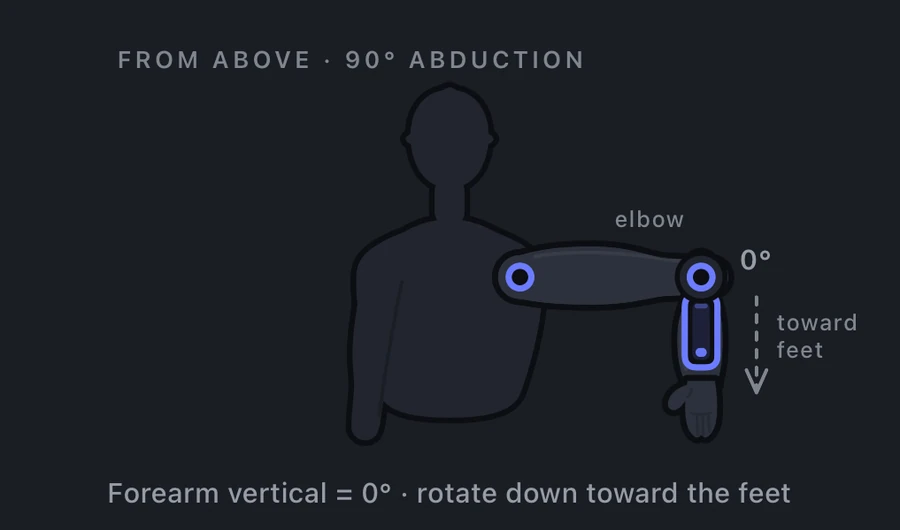
From the same 90°-abduction, elbow-bent position used for external rotation, rotate the forearm forward and down toward the feet. Normal internal rotation is about 70°. As with external rotation, the app uses the phone’s attitude reference so it reads true rotation in any orientation.
Getting a reliable measurement
Shoulder goniometry is most reliable when the same examiner measures the same way each time. Riddle and colleagues, measuring passive shoulder motion in a clinical setting, found intratester (same-examiner) reliability up to ICC .99, but markedly lower intertester (different-examiner) reliability for rotation and horizontal movements. Four habits keep readings repeatable:
- Standardize the position. Measure supine every time, and stabilize the trunk so the scapula and thorax don’t substitute for glenohumeral motion.
- Palpate the landmarks each time rather than eyeballing them — landmarking is the biggest source of variation.
- Read at a stable end range, not mid-motion, and to the whole degree.
- Use one examiner for progress tracking. Compare a patient’s shoulder to their own earlier measurement, taken the same way.
Measuring shoulder ROM with an iPhone
A smartphone goniometer app replaces the two-armed goniometer with the phone’s gravity- and attitude-referenced motion sensor: lay the phone along the arm, set zero, and the change in orientation as the shoulder moves is the joint angle. Peer-reviewed research finds smartphone measurement valid and reliable for shoulder ROM, comparable to a universal goniometer — see the accuracy evidence. A 2023 study found a smartphone application produced shoulder ROM measurements comparable to a physical therapist’s goniometer (Soeters et al.), and a validation study in both healthy adults and postoperative patients found a smartphone clinometer in excellent agreement with the goniometer-based gold standard (ICC 0.98) with the best inter-observer reliability of the methods tested (Werner et al.).
Measure the shoulder on your iPhone. Goniometer shows animated placement for shoulder flexion, extension, abduction, and internal and external rotation, with the AAOS normal range beside every reading — free to measure. Readings save to patient profiles and export as PDF or CSV reports, and patient data stays encrypted on the device. Download Goniometer on the App Store.
Frequently asked questions
What is normal shoulder range of motion?
About 180° flexion, 60° extension, 180° abduction, 90° external (lateral) rotation, and 70° internal (medial) rotation, per AAOS.
How do you measure shoulder flexion with a goniometer?
With the patient supine, center the fulcrum over the lateral acromion, align the stationary arm with the midaxillary line of the trunk and the moving arm with the lateral midline of the humerus, raise the arm overhead, and read the angle.
What landmarks are used to measure the shoulder?
The acromion process (axis), the lateral midline of the humerus toward the lateral epicondyle (moving arm), and the midaxillary line of the trunk (stationary arm).
Where is the fulcrum placed for shoulder flexion?
Over the lateral aspect of the acromion process, with the stationary arm on the midaxillary line of the trunk and the moving arm on the lateral midline of the humerus. For abduction the fulcrum moves to the anterior acromion; for rotation it sits over the olecranon, through the long axis of the humerus. See the placement table above.
How reliable is shoulder goniometry?
Reliable with one examiner: Riddle et al. reported intratester ICC up to .99, though intertester reliability was lower for rotation and horizontal movements. Consistent technique matters most.
Can you measure shoulder range of motion with a phone?
Yes — a smartphone goniometer app reads the phone’s motion sensor, and has shown validity and reliability comparable to a universal goniometer in peer-reviewed research.
References
- Norkin CC, White DJ. Measurement of Joint Motion: A Guide to Goniometry. 5th ed. Philadelphia: F.A. Davis; 2016.
- American Academy of Orthopaedic Surgeons. Joint Motion: Method of Measuring and Recording. Chicago: AAOS; 1965. Normative range-of-motion reference values, as used throughout the Goniometer app.
- Riddle DL, Rothstein JM, Lamb RL. Goniometric reliability in a clinical setting. Shoulder measurements. Physical Therapy. 1987;67(5):668–673. pubmed.ncbi.nlm.nih.gov/3575423
- Soeters R, Damodar D, Borman N, et al. Accuracy of a smartphone software application compared with a handheld goniometer for measuring shoulder range of motion in asymptomatic adults. Orthopaedic Journal of Sports Medicine. 2023;11(7):23259671231187297. doi:10.1177/23259671231187297
- Werner BC, Holzgrefe RE, Griffin JW, et al. Validation of an innovative method of shoulder range-of-motion measurement using a smartphone clinometer application. J Shoulder Elbow Surg. 2014;23(11):e275-e282. doi:10.1016/j.jse.2014.02.030
- Keogh JWL, Cox A, Anderson S, et al. Reliability and validity of clinically accessible smartphone applications to measure joint range of motion: A systematic review. PLOS ONE. 2019;14(5):e0215806. doi:10.1371/journal.pone.0215806
Related guides
Goniometer is an educational and reference tool. It is not a medical device and is not intended for diagnosis or treatment decisions.