
How to document range of motion: Notation, examples, and reports
Reviewed by Kevin Lan, OTR/L, ATP · Updated October 2026
A complete ROM entry states the joint, the movement, whether the motion was active or passive, the side, and the measured arc in degrees from the 0° starting position — for example, Right knee flexion AROM 0–120°. The conventions below are what make a number written today comparable to one written next month, by you or by a colleague.
The 0–180 convention
Standard goniometry uses the 0–180 notation system: every joint starts at 0° in anatomical position, and the recorded value is how far the segment travels from that zero. A shoulder flexed overhead through a full arc is written 0–180°; a knee flexed to 120° is 0–120°. The starting position matters as much as the end number — if the joint cannot reach neutral, say so explicitly (see deficits below) rather than silently measuring from wherever it started.
What a complete entry includes
- Joint and movement — knee flexion, shoulder abduction, wrist ulnar deviation.
- Side — right or left; involved vs. uninvolved.
- AROM or PROM — the patient's own motion and the examiner-assisted arc are different findings; name which one you measured.
- The arc in degrees — from zero: 0–120°, not "120".
- Method, when it matters — instrument and patient position, especially if they deviate from your standard (supine vs. seated changes numbers).
- Clinical qualifiers — pain at end range, end-feel, guarding — when they explain the number.
Documenting deficits and hyperextension
Motion short of neutral needs unambiguous notation. A knee lacking the last 10° of extension can be written as −10° extension, as lacks 10° of extension, or as a flexion arc of 10–120° — all three are used in practice; pick one convention and keep it. Hyperextension is the opposite finding and is written as motion past zero (for example, elbow extension 0° to 10° of hyperextension). Because "10° of extension" alone could mean either, the safest habit is to always mark deficits with a minus sign or the word "lacks."
Example note entries
R knee flexion AROM 0–120°, supine. Pain-free.
// Deficit + comparison to the other side
R knee extension AROM −10° (lacks 10°); L knee extension 0°.
// Progress across visits
R shoulder flexion AROM: 0–95° (6/12) → 0–120° (6/26) → 0–140° (7/10).
// Hand: per-joint + Total Active Motion
R index finger AROM: MCP 0–85°, PIP 0–100°, DIP 0–60°; ext lag PIP −5°. TAM 240° (normal 280°).
Compare to the other side, and to normal
The contralateral limb is the best reference for that patient; published normative values are the population benchmark. Documenting all three — involved, uninvolved, and the AAOS normal range — makes the remaining deficit legible at a glance to anyone who picks up the chart. For the hand, per-digit Total Active Motion compresses twelve joint measurements into one trackable number.
From reading to report
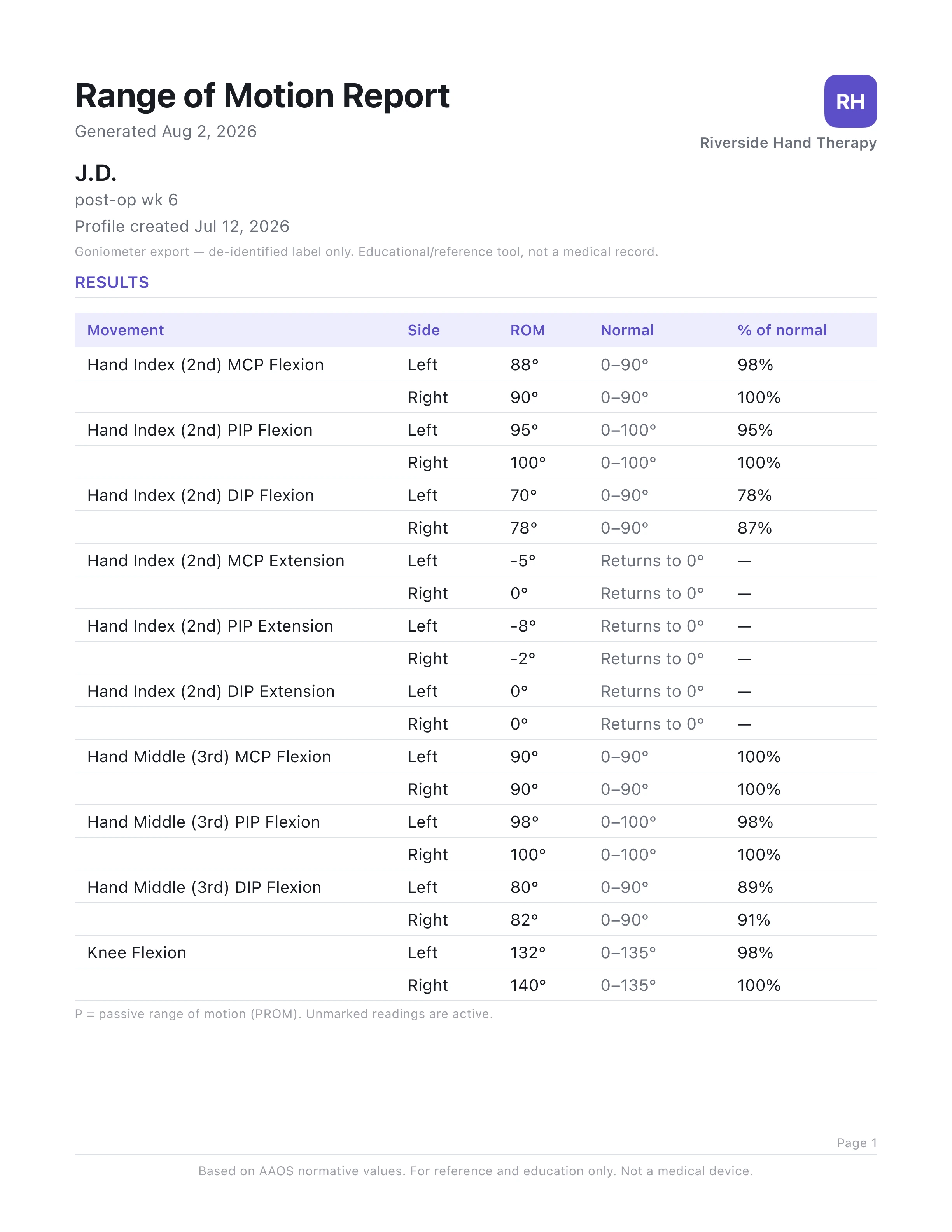
The transcription step — instrument to scratch note to chart — is where measurements get lost or garbled. This is the part software genuinely improves: the Goniometer app saves each reading to a patient profile as it's locked, keeps the arc, side, movement, date, and an active-or-passive (AROM/PROM) tag together, and exports the visit as a PDF or CSV. Free users get watermarked exports and one saved profile; Pro produces watermark-free reports on your clinic's letterhead with progress trend charts across visits — a document ready to drop into the chart. Pro also writes the objective note for you: each latest value with its AROM/PROM tag, the AAOS normal, side-to-side, TAM, and the change since the first measurement, as plain text you copy straight into your EMR.
Frequently asked questions
How do you write ROM in a note?
Joint + movement + AROM/PROM + side + arc from zero: R knee flexion AROM 0–120°. Add instrument, position, and pain/end-feel when relevant.
What does 0–120° mean?
The joint moved from the 0° anatomical starting position through 120 degrees of motion. In the 0–180 system every measurement starts at zero.
How do you document an extension lag?
As degrees short of neutral, marked unambiguously: −10° or lacks 10° of extension. Keep one convention across your notes.
AROM vs. PROM — which goes in the note?
Whichever you measured — and say which. The difference between them is itself a finding worth recording.
Do I compare to normal values or the other side?
Both when possible: contralateral side for the individual baseline, AAOS normals for the population reference.
Measurements that document themselves. Lock a reading, and the joint, side, arc, and date are saved — export the visit as a report, or with Pro copy a paste-ready objective note into your EMR. Download Goniometer on the App Store.

References
- Norkin CC, White DJ. Measurement of Joint Motion: A Guide to Goniometry. 5th ed. Philadelphia: F.A. Davis; 2016.
- American Academy of Orthopaedic Surgeons. Joint Motion: Method of Measuring and Recording. Chicago: AAOS; 1965. Normative range-of-motion reference values, as used throughout the Goniometer app.