
Goniometer vs. inclinometer: What's the difference?
Reviewed by Kevin Lan, OTR/L, ATP · Updated July 2026
Both instruments measure joint range of motion in degrees — the difference is the reference. A universal goniometer measures the angle between two limb segments, using arms you align with anatomical landmarks. An inclinometer measures the tilt of one segment relative to gravity, from a zeroed starting position. Smartphone goniometer apps are digital inclinometers: the phone's motion sensors are gravity-referenced, so one placement replaces two arms and a fulcrum.
How a universal goniometer works
The universal goniometer is a protractor with two arms. You palpate the joint's landmarks, center the fulcrum over the joint axis, align the stationary arm with the proximal segment and the moving arm with the distal segment, then read the angle where the arms cross the scale. It is inexpensive, familiar, and the convention in most textbooks and documentation — and its main error source is well known: keeping a fulcrum and two arms visually aligned over a moving joint while also stabilizing the patient. Human studies commonly report 5° or more of inter-rater variability, driven mostly by landmarking and alignment rather than the instrument itself.
How an inclinometer works
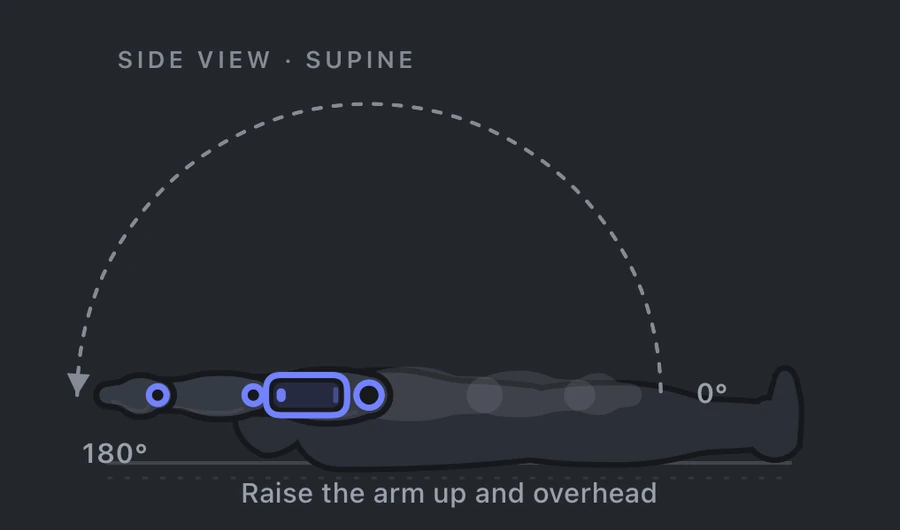
An inclinometer reads tilt against gravity — classically a fluid-filled bubble dial strapped or held to the limb, and digitally the fused accelerometer/gyroscope inside a phone. You place it on the moving segment, zero it at the starting position, take the joint through its range, and the change in tilt is the joint angle. Because gravity is the reference, there is no fulcrum to hold over the axis and no second arm to align: one placement, one hand, a reading to the degree. How dedicated electronic instruments compare with phone apps is covered in the digital goniometer explainer.
Side by side
| Universal goniometer | Inclinometer (incl. phone apps) | |
|---|---|---|
| Reference | Anatomical landmarks (two segments) | Gravity (one segment, zeroed start) |
| Technique | Fulcrum over joint axis + two arms aligned | Single placement on the moving segment |
| Hands needed | Usually two | One |
| Main error source | Visual alignment and landmarking | Placement consistency and patient position |
| Spine & rotation | Awkward — no clean two-arm alignment | Well suited |
| Reading | Read the protractor by eye | Digital readout to the degree |
| Records the result | No — transcribe by hand | Apps can save, chart, and export |
Which should you use?
For hinge joints with accessible landmarks — elbow, knee — both work well, and the universal goniometer remains the documentation convention. Inclinometers earn their keep where two-arm alignment gets awkward: cervical and spinal motion, rotation movements, and one-handed measurement while you stabilize the limb. The peer-reviewed comparisons are reassuring in both directions: a 37-study systematic review found smartphone inclinometry valid and reliable across the upper limb, lower limb, and spine, and in several head-to-head studies the phone matched the goniometer's validity while beating its repeatability — removing the eyeballing removes an error source. The study-by-study evidence is on the accuracy research page.
In practice the modern answer is: the instrument in your pocket is an inclinometer. The Goniometer app uses the phone's gravity-referenced sensors with guided placement for each movement, AAOS normal values beside every reading, and — because it is software — it also records, charts, and documents the result, which neither classic instrument can do.
Frequently asked questions
What is the difference between a goniometer and an inclinometer?
A goniometer measures the angle between two limb segments using aligned arms; an inclinometer measures one segment's tilt relative to gravity from a zeroed start. Both report ROM in degrees.
Which is more accurate?
Both are accepted clinical instruments, and standardized technique matters more than the tool. Inclinometers remove the two-arm alignment step, which is why phone-based inclinometry has shown equal-or-better repeatability in several studies — see the evidence summary.
Is a phone goniometer app a goniometer or an inclinometer?
Method-wise it's a digital inclinometer; job-wise it's a goniometer. Apps built on the validated method read the phone's gravity-referenced motion sensors — the full walkthrough is in the iPhone goniometer explainer.
When is an inclinometer the better choice?
Spinal and cervical motion, rotation movements, and any measurement where you need a free hand. For elbows and knees, either instrument works well with good technique.
The inclinometer already in your pocket. Guided placement for 55 movements, AAOS normal values, free to measure. Readings save to patient profiles and export as PDF or CSV reports, and patient data stays encrypted on the device. Download Goniometer on the App Store.

References
- Keogh JWL, Cox A, Anderson S, et al. Reliability and validity of clinically accessible smartphone applications to measure joint range of motion: A systematic review. PLOS ONE. 2019;14(5):e0215806. doi:10.1371/journal.pone.0215806
- Buck C, Martindale B, Braden HJ. Goniometry apps: Do they measure up? Exploring the accuracy of mobile device apps. Gerontology & Geriatrics Studies. 2019;5(2). crimsonpublishers.com/ggs/fulltext/GGS.000610.php
- Milanese S, Gordon S, Buettner P, et al. Reliability and concurrent validity of knee angle measurement: Smart phone app versus universal goniometer used by experienced and novice clinicians. Man Ther. 2014;19(6):569-574. doi:10.1016/j.math.2014.05.009
- Norkin CC, White DJ. Measurement of Joint Motion: A Guide to Goniometry. 5th ed. Philadelphia: F.A. Davis; 2016.
- American Academy of Orthopaedic Surgeons. Joint Motion: Method of Measuring and Recording. Chicago: AAOS; 1965. Normative range-of-motion reference values, as used throughout the Goniometer app.