
Finger goniometer: The small-joint tool vs. your phone
Reviewed by Kevin Lan, OTR/L, ATP · Updated September 2026
A finger goniometer is a small goniometer sized for the digits — short arms, compact protractor — placed on the dorsal (back) surface of the finger to measure the MCP, PIP, and DIP joints. It exists because a full-size goniometer is unwieldy on bones an inch long. A smartphone goniometer app solves the same problem differently: laid along the bone, the phone reads the joint's rotation from its motion sensors, matches the traditional tool to within 5° in peer-reviewed testing, and computes Total Active Motion automatically. Here is how the two compare, and when each makes sense.
What a finger goniometer is
Traditional finger goniometers are shrunken versions of the universal goniometer: clear plastic or stainless steel, arms a few centimeters long, and a protractor read by eye. Technique follows the standard for small joints — goniometer on the dorsal surface of the digit rather than the side, fulcrum centered over the joint, arms along the midlines of the two phalanges it connects. The hand & finger ROM guide walks through the full step-by-step technique, joint by joint.
Using your phone as a finger goniometer
A phone is obviously bigger than a finger, so a smartphone app can't straddle a PIP joint with two tiny arms. Instead it uses a two-placement method suited to small bones: lay the phone along the back of the bone before the joint and set zero, then lay it the same way along the bone after the joint and bend to end range — the total rotation between the two placements is the joint angle. One placement per bone, no visual alignment to hold, and the reading is digital to the degree.
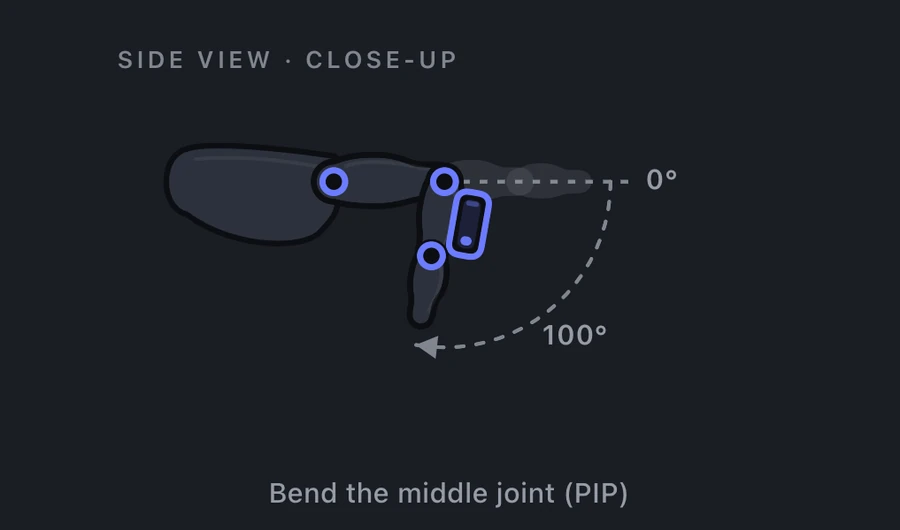
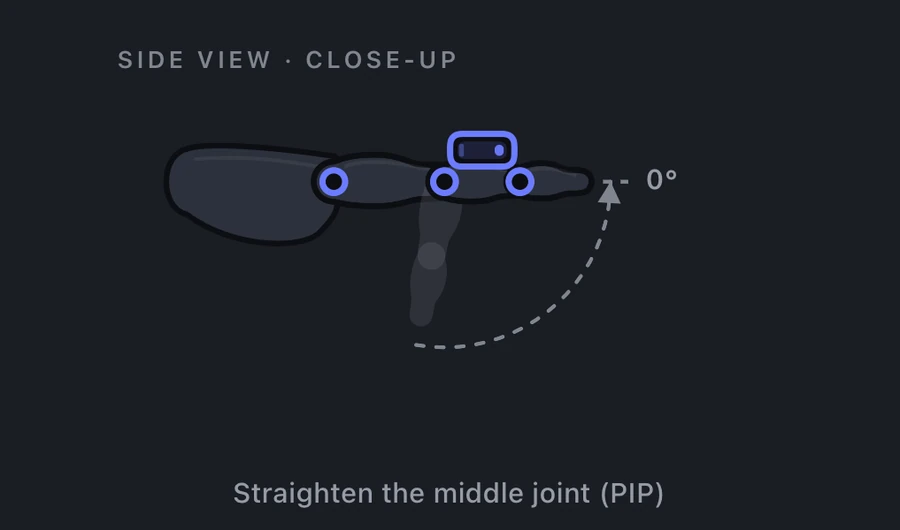
Finger goniometer vs. smartphone app
| Finger goniometer | Smartphone goniometer app | |
|---|---|---|
| Hardware cost | ~$10–$30 plastic; more in steel | None — uses your phone |
| Readout | Protractor, read by eye | Digital, to the degree |
| Technique | Fulcrum + two short arms aligned dorsally | Two placements, one per bone, guided on screen |
| TAM (Total Active Motion) | Computed by hand from 6 readings | Computed automatically per digit (Pro) |
| Normal values at hand | No — look them up | Yes — AAOS range beside the reading |
| Records & charts results | No — transcribe by hand | Yes — saved profiles, trends, PDF/CSV reports |
| Reliability evidence | The long-standing standard | Agreement within 5° of the goniometer on every finger joint (Theile 2022) |
The honest trade-off: a dedicated finger goniometer is smaller in the hand and needs no battery, and decades of clinical convention are built on it. The app's case is everything that happens after the reading — automatic TAM (with Pro), the normal range on screen, and measurements that land in a patient profile instead of on a sticky note.
Normal finger and thumb range of motion
| Movement | Normal ROM |
|---|---|
| Finger MCP flexion (index–little) | 90° |
| Finger PIP flexion | 100° |
| Finger DIP flexion | 90° |
| Thumb MCP flexion | 50° |
| Thumb IP flexion | 80° |
Full extension returns each joint to 0° neutral; hyperextension reads past it. The complete chart for every joint is on the normal ROM values page.
Total Active Motion, computed for you
Hand therapy summarizes a finger's motion as Total Active Motion (TAM): MCP + PIP + DIP flexion, minus any extension lag — normally about 260–280° per finger, thumb excluded by convention. With a traditional finger goniometer that means six readings and arithmetic per digit. With Pro, the Goniometer app computes TAM automatically as you measure, per finger, and carries it into the exported report along with a side-to-side comparison.
Frequently asked questions
What is a finger goniometer?
A small goniometer sized for the digits, placed on the dorsal (back) surface of the finger with the fulcrum over the joint and the arms along the two phalanges. A smartphone goniometer app laid along the bone measures the same joints with the phone's motion sensors.
Can a phone replace a finger goniometer?
Yes — a 2022 comparative study found smartphone finger goniometry as reliable as a universal goniometer, with every finger joint agreeing within 5°. The phone uses a two-placement method: zero on the bone before the joint, then measure from the bone after it.
How do you measure finger ROM without a finger goniometer?
Support the hand with the wrist neutral, lay the phone along the back of the bone before the joint and set zero, then lay it along the bone after the joint and bend to end range. Full technique in the hand & finger ROM guide.
What is a normal finger range of motion?
About 90° flexion at the MCP, 100° at the PIP, and 90° at the DIP; the thumb reaches about 50° (MCP) and 80° (IP), per AAOS. Extension returns each joint to 0°.
What is Total Active Motion (TAM)?
A finger's MCP + PIP + DIP flexion minus any extension lag — normally about 260–280°. The app computes it automatically per digit; with a manual tool you measure six values and do the arithmetic.
How much does a finger goniometer cost?
Roughly $10–$30 for plastic models, more for stainless. The Goniometer app measures every finger and thumb joint free — no extra hardware — with an optional one-time Pro upgrade for documentation features.
The finger goniometer already in your pocket. Every finger and thumb joint, flexion and extension, AAOS normal values beside every reading — free to measure, with automatic Total Active Motion in Pro. Readings save to patient profiles and export as PDF or CSV reports, and patient data stays encrypted on the device. Download Goniometer on the App Store.

References
- Theile H, Walsh S, Scougall P, Ryan D, Chopra S. Smartphone goniometer for reliable and convenient measurement of finger range of motion: a comparative study. Australasian Journal of Plastic Surgery. 2022;5(2):37–43. doi:10.34239/ajops.v5n2.335
- Keogh JWL, Cox A, Anderson S, et al. Reliability and validity of clinically accessible smartphone applications to measure joint range of motion: A systematic review. PLOS ONE. 2019;14(5):e0215806. doi:10.1371/journal.pone.0215806
- Norkin CC, White DJ. Measurement of Joint Motion: A Guide to Goniometry. 5th ed. Philadelphia: F.A. Davis; 2016.
- American Academy of Orthopaedic Surgeons. Joint Motion: Method of Measuring and Recording. Chicago: AAOS; 1965. Normative range-of-motion reference values, as used throughout the Goniometer app.
Goniometer is an educational and reference tool. It is not a medical device and is not intended for diagnosis or treatment decisions.