
Digital goniometer: Devices vs. smartphone apps
Reviewed by Kevin Lan, OTR/L, ATP · Updated July 2026
A digital goniometer is any instrument that measures joint range of motion electronically and displays the angle as a digital readout — no protractor scale to read by eye. The category spans dedicated handheld devices, digital inclinometers, and smartphone goniometer apps, which turn the phone's built-in motion sensors into the same instrument. They all report ROM in degrees; they differ in price, in what else they can do with the reading, and in whether you have to buy new hardware at all.
What counts as a digital goniometer
- Dedicated digital goniometers — two-armed electronic instruments that replace the protractor scale with a sensor and an LCD readout. Aligned to landmarks exactly like the classic tool.
- Digital inclinometers — single-placement devices that read tilt against gravity, common for spinal and rotation measurements where two-arm alignment is awkward.
- Smartphone goniometer apps — software that reads the phone's gravity-referenced accelerometer and gyroscope. Method-wise these are digital inclinometers; the iPhone goniometer explainer covers exactly how the sensing works.
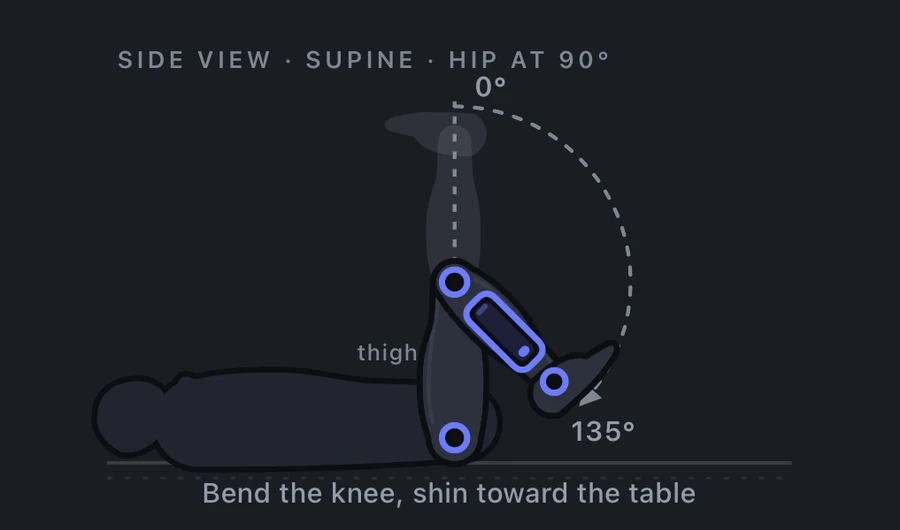
Devices vs. apps, side by side
| Dedicated digital device | Smartphone goniometer app | Universal goniometer | |
|---|---|---|---|
| Hardware cost | Tens to hundreds of dollars | None — uses your phone | $10–$50 |
| Readout | Digital, to the degree | Digital, to the degree | Protractor, read by eye |
| Technique | Two arms or single placement | Single placement, guided on screen | Fulcrum + two arms aligned |
| Normal values at hand | No — look them up | Yes — AAOS range beside the reading | No — look them up |
| Records & charts results | Rarely | Yes — saved profiles, trends, PDF/CSV reports | No — transcribe by hand |
| Peer-reviewed validation | Varies by model | 37-study systematic review (Keogh 2019) | The long-standing reference standard |
| Always with you | Only if you carry it | Yes | Only if you carry it |
Accuracy: What the research shows
Digital readouts do not just save squinting at a scale — they remove the step where most measurement error lives. With a universal goniometer, the examiner keeps a fulcrum and two arms visually aligned over a moving joint; with a digital inclinometer or phone app, one placement and a zeroed start replace all of it. A 37-study systematic review found smartphone apps valid and reliable for measuring ROM across the upper limb, lower limb, and spine (Keogh et al., 2019), and in a head-to-head knee comparison the phone produced less measurement error than the universal goniometer in the same clinicians' hands (Milanese et al., 2014). The full study-by-study summary, including agreement with radiographs and surgical navigation, is on the accuracy research page.
Which should you choose?
If you already measure with a universal goniometer and it serves you well, there is no urgency to change — technique matters more than instrument. But if you are considering buying a digital goniometer, it is worth asking what the extra hardware buys you: the phone in your pocket already senses angles the same way, and software can do what no handheld readout can. The Goniometer app adds guided placement for 55 movements, the AAOS normal range beside every reading, and — with Pro — saved patient profiles, progress charts, PDF/CSV reports on your clinic letterhead, and a paste-ready objective note for the EMR. Measuring is free, so you can compare it against your current instrument before changing anything about your workflow. For how the underlying methods differ, see goniometer vs. inclinometer.
Frequently asked questions
What is a digital goniometer?
Any instrument that measures joint ROM electronically with a digital readout: dedicated handheld devices, digital inclinometers, and smartphone goniometer apps. All report the angle in degrees.
Is a smartphone app a real digital goniometer?
Yes — the phone's gravity-referenced sensors use the same digital inclinometer method as dedicated devices, and a 37-study systematic review found smartphone ROM measurement valid and reliable across the upper limb, lower limb, and spine.
How much does a digital goniometer cost?
Dedicated devices run from tens to several hundred dollars. A phone app needs no new hardware — the Goniometer app is free to measure every joint, with an optional one-time Pro upgrade for documentation features.
Is a digital goniometer more accurate than a universal goniometer?
Comparably valid with good technique, but digital instruments remove the visual-alignment step and read to the degree, which improves repeatability — in one knee study the phone app showed less measurement error than the universal goniometer.
The digital goniometer already in your pocket. Guided placement for 55 movements, AAOS normal values, free to measure. Readings save to patient profiles and export as PDF or CSV reports, and patient data stays encrypted on the device. Download Goniometer on the App Store.

References
- Keogh JWL, Cox A, Anderson S, et al. Reliability and validity of clinically accessible smartphone applications to measure joint range of motion: A systematic review. PLOS ONE. 2019;14(5):e0215806. doi:10.1371/journal.pone.0215806
- Milanese S, Gordon S, Buettner P, et al. Reliability and concurrent validity of knee angle measurement: Smart phone app versus universal goniometer used by experienced and novice clinicians. Man Ther. 2014;19(6):569-574. doi:10.1016/j.math.2014.05.009
- Buck C, Martindale B, Braden HJ. Goniometry apps: Do they measure up? Exploring the accuracy of mobile device apps. Gerontology & Geriatrics Studies. 2019;5(2). crimsonpublishers.com/ggs/fulltext/GGS.000610.php
- Norkin CC, White DJ. Measurement of Joint Motion: A Guide to Goniometry. 5th ed. Philadelphia: F.A. Davis; 2016.
- American Academy of Orthopaedic Surgeons. Joint Motion: Method of Measuring and Recording. Chicago: AAOS; 1965. Normative range-of-motion reference values, as used throughout the Goniometer app.